Setting up an RCP
 Updated
by Nicolas Vodoz
Updated
by Nicolas Vodoz
General Definition and Operation
Since 2018, with the entry into force of the revised Energy Act (EnA), it has been possible to create Self-consumption communities (RCP) in Switzerland. An RCP allows several final electricity consumers to be grouped into a single consumer and customer in the eyes of the distribution system operator (DSO), with the aim of consuming shared photovoltaic electricity production, produced for example on the roof of their building.
An RCP is traditionally established within a single building, with a single DSO meter installed at the building's electrical input. The owner or the community of co-owners (PPE) then becomes the electricity supplier for the residents, who waive their basic supply from the DSO. Designated as the RCP manager, the owner then mandates a company, such as Climkit, to manage metering and billing within the RCP.
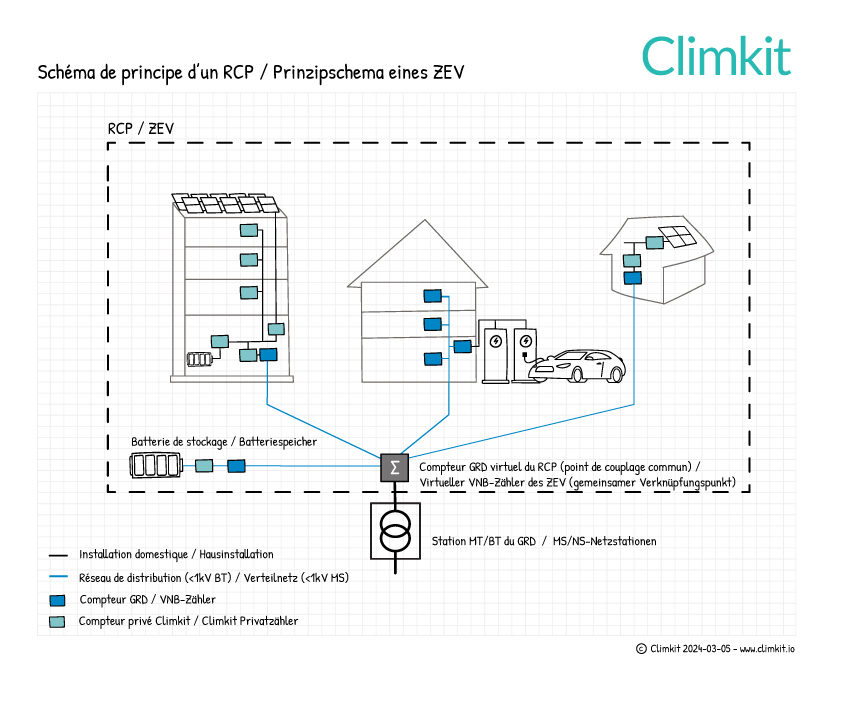
Since January 1, 2025, it is possible to set up an RCP with neighboring buildings using the distribution grid to exchange the solar electricity produced. In this case, the DSO creates a virtual meter resulting from the sum of the DSO meters installed in each building, thus allowing for a single invoice. This is referred to as a virtual RCP. Apart from these differences in general metering, the rules for establishment and operation are the same, whether an RCP consists of one or several buildings.
The RCP is considered a single customer, and its manager is the sole interlocutor for the DSO, which bills the electricity withdrawn by the RCP and remunerates, at the feed-in tariff, the surplus solar energy fed back. If several DSO meters are used for metering, the usage and maintenance fees for these meters are also billed to the RCP.
Conditions for Implementation
To set up an RCP, the following conditions must strictly be met:
- The total photovoltaic (PV) power must correspond to at least 10% of the grid connection power. For example, a 125 A building must be equipped with a PV installation of at least 8.7 kWp, which represents approximately twenty photovoltaic panels.
- If the RCP is established in an existing building, the written agreement of the residents interested in joining the RCP is required.
- If the RCP is formed between several buildings, they must be connected to the same coupling point on the low-voltage grid (<1 kVA).
Steps for Implementation
1. Initial Verification with the DSO
If several buildings are involved, it is necessary to consult the DSO by providing the address of the main building, for example, the one where a new photovoltaic system is planned. The DSO should be asked to identify neighboring buildings eligible to participate in the RCP. This request can be made by any interested person. The DSO responds within 14 days with a list of eligible buildings based on the electrical grid topology.
2. Request for Establishment and Designation of the Manager
The request to establish the RCP is made by the electrical installer mandated by the owner during the request for building connection or production facility installation via the dedicated form provided by the DSO and signed by all future RCP members.
A manager and RCP interlocutor must also be designated for the DSO. This is generally the owner or the PPE. In cases where the RCP consists of several buildings with different owners, they must agree to designate one. Usually, it is the one with the main PV installation seeking to sell their production to residents of neighboring buildings through this expanded RCP. It is recommended to establish an agreement between owners on how the RCP will be operated.
The DSO then has three months to review the request. Residents not wishing to join the RCP remain DSO customers, and the DSO will deduct their consumption from the overall DSO invoice without needing to modify the wiring. Once that person leaves the building, their apartment can easily be integrated into the RCP.
In an Existing Building
If the RCP is established in a building with existing leases, it is essential to obtain the agreement of each tenant. Within a PPE, the agreement of each co-owner is necessary. The letter template below can be used to inform residents and collect their consent for the creation of an RCP:
In a New Building
If the premises are free of any lease at the time of the RCP's establishment (for example, during a move or in the case of a new building), the owner can require new tenants to join the RCP. This obligation can be integrated into the lease agreement or stipulated in a separate electricity supply contract.
Lease Agreement Clause for RCP
The lessor is the representative of the self-consumption community (RCP), responsible for the electricity supply, metering, and billing of the tenants. The costs attributable to the tenant are as follows: costs for electricity withdrawn from the grid
- Costs for self-consumed solar electricity
- Costs of individual meters
- Management fees (meter reading, administration, and billing)
The lessor may outsource the management of the RCP to a third-party provider. In any case, the lessor cannot be held responsible for any power supply interruptions from the grid (blackout) or the photovoltaic installation.
3. Planning of the Metering System
DSO meters can be used for internal RCP metering, even if consumers have waived their individual connection. Due to the high monthly cost of DSO meters (CHF 6 to 10 per month), it is advisable to limit them as much as possible, particularly at building inputs, and to prioritize the installation of private meters to measure internal consumption (apartments and common areas) as well as the production of various photovoltaic installations.
Furthermore, private meters offer significant advantages: in case of failure or metering disputes, the owner can directly call an independent electrical installer without depending on the DSO. Moreover, unlike DSO meters which only transmit data once a day, private meters can allow real-time monitoring, essential for adjusting consumption habits and optimizing solar production use.
The planning of the metering system is a crucial aspect that requires a thorough evaluation of the situation, taking into account one-time installation costs and recurring costs that will be borne by the owner and consumers during the operational phase. All these elements must be determined by the owner and their representatives, engineers, and electrical installers before the start of installation work.
4. Installation and Commissioning
The installer proceeds with the installation of photovoltaic panels and modifications to the metering system, including the removal of DSO meters, the installation of new private meters, as well as the potential preparation of locations for DSO input and production meters.
Retrieval of DSO Meter Data
To manage the RCP, if several DSO meters are kept, Climkit will need their readings in the same way it collects data from private meters. Climkit therefore coordinates with the DSO to organize the daily and digital transfer (via FTP) of DSO meter data in the standardized SDAT-CH (Ebix) format to the Climkit platform. A one-time setup fee is billed based on the number of meters to perform this integration.
5. Administrative Setup
Climkit contacts the owner responsible for the RCP to establish the management contract and settle the administrative procedures necessary for operating the RCP, such as defining billing rates and the list of members. The owner also signs a proxy allowing the DSO to send its invoice directly to Climkit.
6. Operational Phase
The RCP then enters the operational phase, and Climkit manages the RCP by generating individual statements for consumers based on their consumption read from both private and DSO meters. For each consumer, the share of electricity from the photovoltaic installation is distinguished from that coming from the grid.
If the owner has opted for the full operating method, Climkit bills consumers directly and manages payments. Thanks to the proxy signed with the DSO, Climkit receives and periodically pays the invoice related to the RCP's grid withdrawal. Once a year, an annual statement is established in favor of the owner responsible for the RCP to credit them with the revenue related to the sale of solar electricity.
In cases where several photovoltaic installations belonging to different owners are part of the RCP, the annual statement clearly details the production of each installation, thus allowing revenues to be distributed among owners according to their own agreement.