Installer
Planning
Installer getting started guide (read first)
Global planning of a Climkit site
Climkit site implementation process
Plan the connection of the Climkit Gateway and network connectivity
Plan electricity management (RCP, RCPv and LEC)
Plan energy optimization and storage
Plan the management of electric vehicle charging stations
Plan the management of heating, water and ancillary costs
Plan collective laundry management
Plan eBike charging management
General terms and conditions of sale
Platform configuration
Request for an Installer account
Creation of a new site
Add the router (4G or LAN)
Adding the Climkit Gateway
Adding electricity meters
Save the photovoltaic installation information
Save battery information
Adding charging stations
Add the OCPP Remote electric vehicle charging station
Add the 4-relay I/O module
Add RFID readers
Adding heat and water meters
Installation and connection
Install the 4G Router
Install the LAN router
Install the Climkit Gateway
Install the RS485-Ethernet converter
Install the M-Bus converter
Install the standard Ethernet switch
Install the PoE Ethernet switch
Install the Wi-Fi access points
Install electricity meters
Install the charging stations
Install heat and water meters
Install the RFID reader
Install the three-phase Relay meter
Install the Shelly relay meter
Install the 4-relay I/O module
Verification and testing
Owner
Administrative setup
Getting started guide - Administrative setup
Form - 1. Contact details
Form - 2. Solutions
Form - 3. Billing rates
Contract and documents to complete
Online account for owners
Information flyers for consumers
Online access, RFID badge and charging stations
FAQ and other information
Resident
Account and app
Electricity invoice
Electric vehicle charging station
Building laundry room
Electric vehicle charging (eBike)
Platform
Platform Access
Terminology
Accounts and contacts
Site
Settings
Creation/editing of a note or an issue to be processed
Close an issue to be processed
Site statuses
Add/Modify the building(s)
Steps for commissioning a site
Delete/deactivate a site
Add/Modify equipment
Edit the basic information of a site
Equipment
Add/modify a gateway
Add/modify a router
Add/modify an electricity meter
Bulk insert meters
Bulk assign meters to a gateway
Add/modify a distribution zone
Add/modify a charging station
Add/modify a thermal or water meter
Add/edit a Distribution system operator (DSO) meter (FTP transfer)
Connecting remotely to a Climkit gateway
Administration
Stakeholders
Management terms
View site management conditions
Activation/deactivation of a solution
Configuration of the operating method
Visualize the financial conditions
Creation/edition/addition of a financial condition
Deleting a financial condition
Accounts
Create a consumer account
Create a contact
View and download the invoices of an account
Send Platform Access to a contact
Add/modify the billing address
Link an existing account to a site
Change the correspondence method
Rates and billing points
Creation/editing of a billing point
Record a move (transfer)
Assignment of an account to a billing point
Add/modify the default charge advance payment for a billing point
View the rates of the consumption site
Editing a consumption tariff
Creation/edition of a consumption billing rate
Creation/editing of a consumption tariff component
View fixed rates and subscriptions
Customize invoice line item labels/titles
View the Financial conditions billed to the Billing points
RFID badges
Accounting
Tools
Meter inspection
Visualization
Expense statements
Introduction to the Expense statement generation tool
Create/edit an accounting period for expense statements
Modify the expense statement settings
Add/modify a general expense supplier invoice for an expense statement
Edit the collected advance payments of an expense statement
Particularity of room heating and hot water production fees
Verify and download the meter readings for the expense statements period
Perform the cost allocation and generate the expense statements
Export individual consumption for the expense statement period
API
Table of Contents
- Categories
- Installer
- Installation and connection
- Install the Climkit Gateway
Install the Climkit Gateway

This article describes the on-site installation of the Gateway. For the equipment to function, configuration on the Climkit platform is also required. Links are available at the end of the document.
Installation of the Climkit Gateway
- Connect the power supply cable from the 24V AC/DC power supply to the + and - ports of the device.
- Connect the RS485 bus of the Modbus meters to the A, B, and SG (for GND) ports of the device.
- Connect the Ethernet/RJ45 (LAN) port to the router.
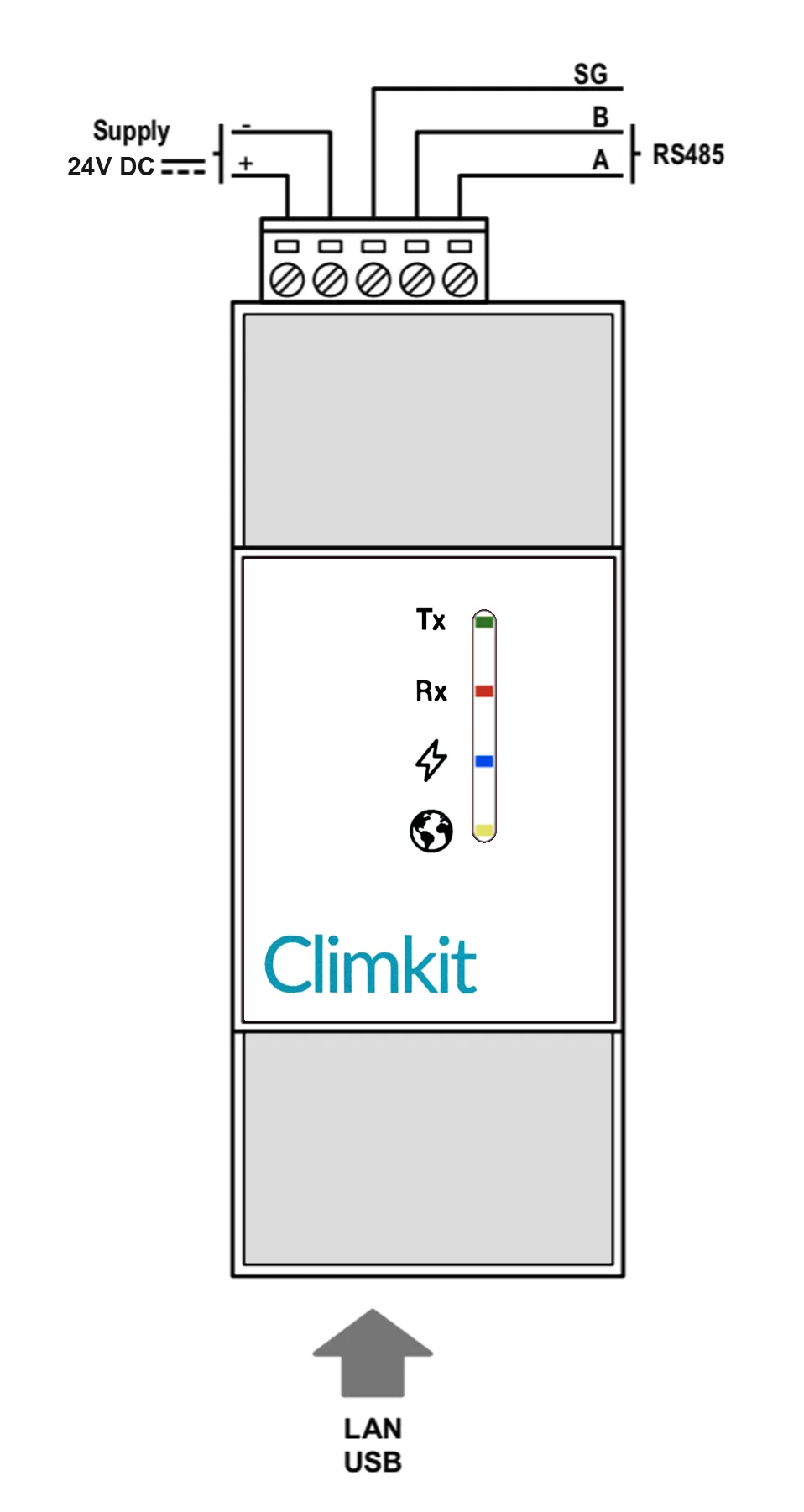
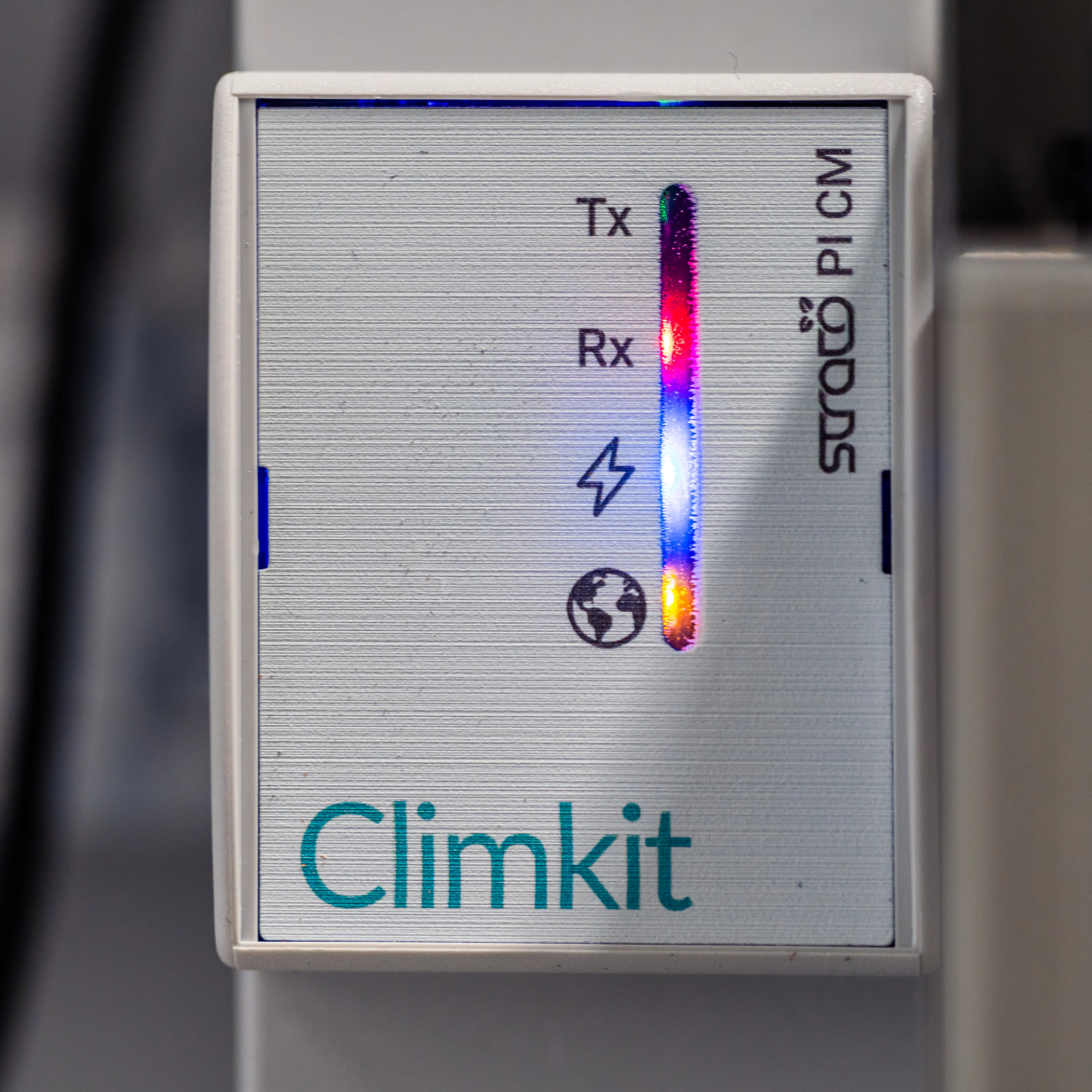
- The device starts in a few minutes and 4 LEDs on the front panel indicate the Gateway status:
- "Lightning bolt" lit in blue: the Gateway is correctly powered. It flashes during startup.
- "Globe" in orange indicates the connection status:
- rapid flashing: the Gateway has started correctly but is not configured. It must be added to a site so that it can download its configuration, specifically the list of meters to read on the site.
- slow flashing: the Gateway has started correctly but is not connected to the Internet. Check the connection to the router.
- steady light: the Gateway has started, is configured, and is connected to the Internet.
- "Tx" flashes: the Gateway is sending a reading command to a device, such as an electricity meter, connected to the RS485 bus.
- "Rx" flashes: the Gateway is receiving the requested information from the device. When the Gateway successfully reads a meter, Tx and Rx flash almost simultaneously.
Climkit Gateway firewall network requirements
In the event that the Climkit Gateway is connected to a third-party IT network, it is essential to configure the endpoints and ports below.
Destination | Port | Protocol |
*.climkit.io | 80, 443 | HTTP, HTTPS |
*.climkit.link | 80, 443 | HTTP, HTTPS |
*.climkit.link | 22 (outbound) | SSH |
*.pool.ntp.org | 123 | NTP (UDP) |