Table of Contents
Plan energy optimization and storage

This article describes the planning of the installation. For on-site implementation and equipment configuration on the Climkit platform, refer to the links at the end of the article.
Climkit's Energy Management System (EMS) controls certain devices based on solar production and manages a storage battery to make the most of surplus energy, for example at night.
Locally produced solar electricity is better utilized: the self-consumption rate increases, electricity purchases from the grid decrease, and the building gains autonomy. It is also possible to program timers to systematically switch on certain devices at different times of the day.
This article is divided into two parts: device control and the storage battery.
1. Device control
The Climkit EMS controls devices via a relay or communication protocol based on surplus solar production (fed back to the grid) or according to programmed timers. The main use cases are hot water production, heat pumps, and electric vehicle charging.
Hot water production
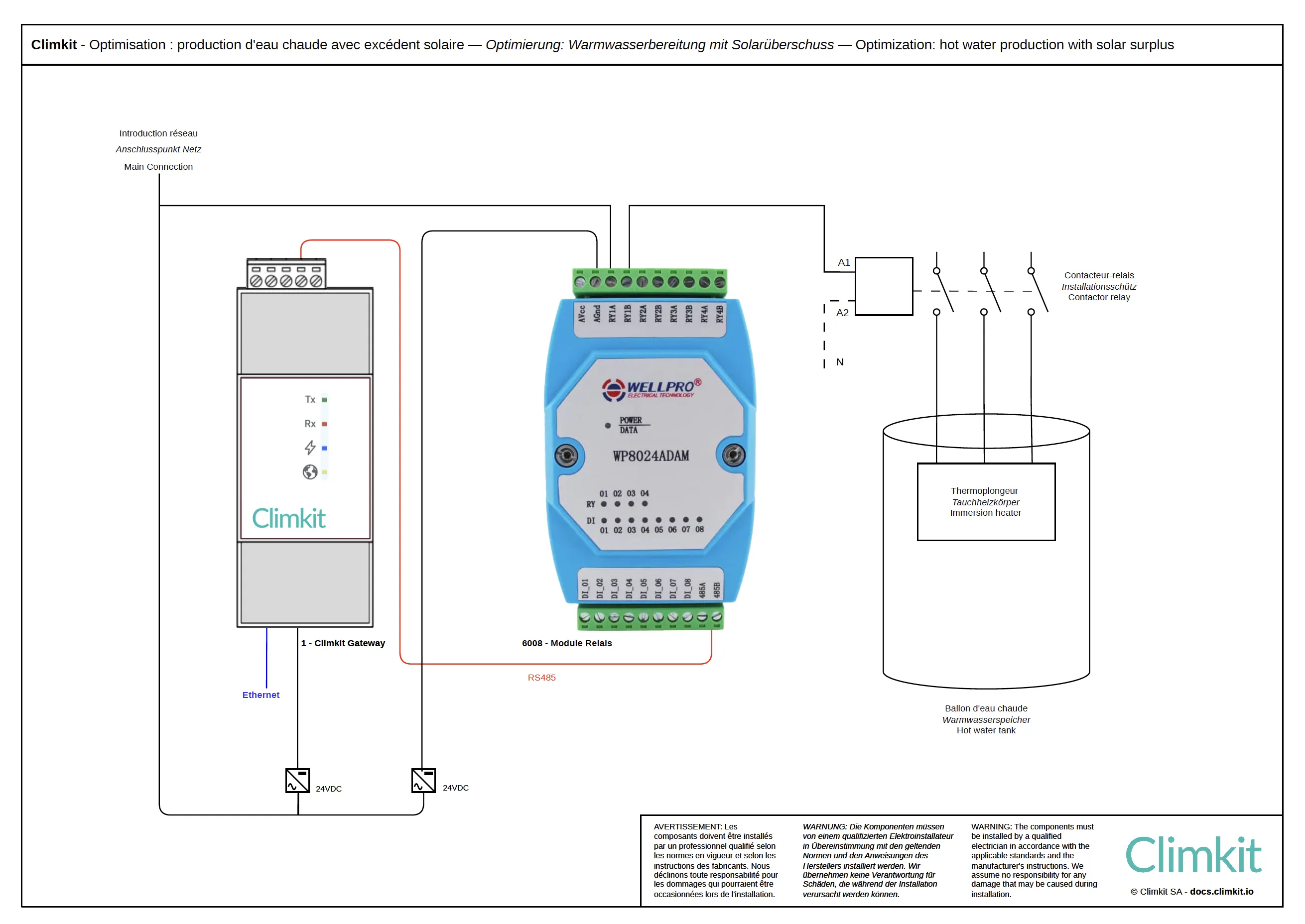
The EMS controls an immersion heater (electric heating element) installed in the hot water tank, solely based on surplus solar production. The power of the heating element is configured in the Climkit EMS; when equivalent or greater solar power is fed back to the grid, the relay activates the heating element, which produces hot water for space heating or domestic hot water (DHW).
The immersion heater is inexpensive to purchase and highly responsive. It is often already present in the tank, as the primary water heater or as a backup for a heat pump. It is an effective way to store solar energy in the form of hot water.
Heat pump
Heat pumps (HP) also produce hot water, both for heating and domestic hot water (DHW).
Unlike a simple immersion heater, a heat pump must be controlled via relay contacts called SG-Ready. This signal indicates to the heat pump that surplus solar electricity is available. It can then react according to its own programming, for example by increasing its setpoint temperature to store more hot water.
The Climkit Gateway can control these SG-Ready contacts in the same way as an immersion heater. Please note, however, that the Gateway only transmits the solar surplus signal to the heat pump management system, but does not replace it.
To maximize solar self-consumption, we recommend programming the heat pump to operate primarily between 9:00 AM and 6:00 PM. If the heat pump runs at night and fills its hot water tank to the maximum, it will not turn on during the day, even in the event of high solar production. However, settings should always be adjusted to maintain an adequate hot water level in the morning!
Charging station control
Charging stations can be configured to charge plugged-in vehicles solely using solar energy. This feature does not require any additional equipment beyond the infrastructure planned for the charging stations (see Planning electric vehicle charging station management).
Users wishing to charge their vehicle independently of this mode can activate the corresponding charging mode via the Climkit mobile app.
Climkit offer
Here are the additional products allowing device control:
- Equipment:
- I/O Relay Module
- Software features:
- Self-consumption optimization
- Commissioning service:
- Technical coordination and configuration
All these products are ordered directly from Climkit. As a general rule, an on-site intervention by a Climkit technician is not required for commissioning. Components are delivered preconfigured, allowing the installer to easily carry out commissioning, with telephone assistance from Climkit technical support if needed.
Details of equipment used
I/O Relay Module
The WP8024 I/O Module provided by Climkit has 4 relays.
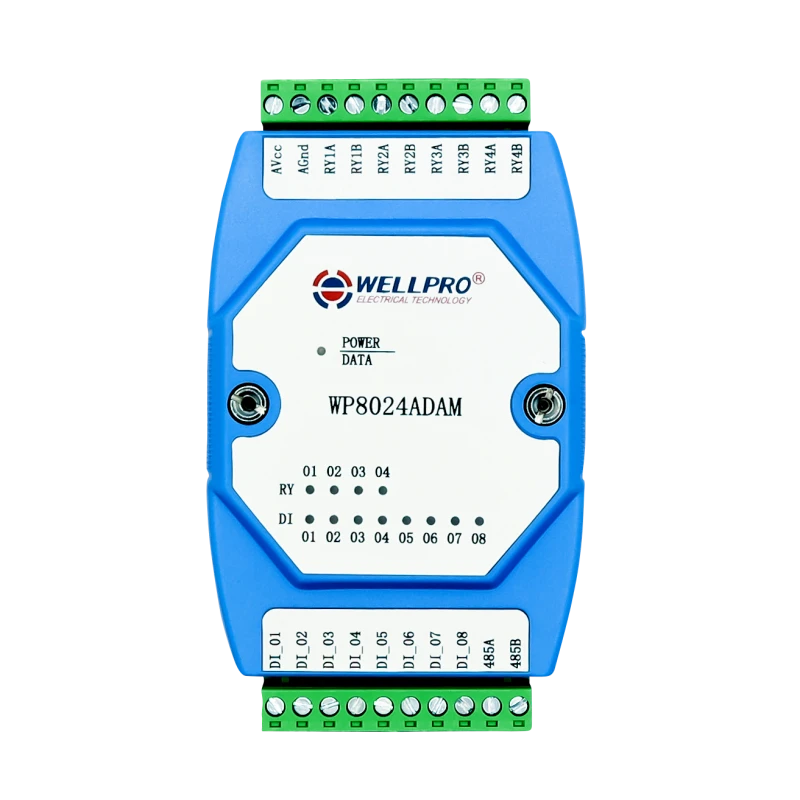
It comes with a 24V DC DIN rail power supply and connects to the Climkit Gateway via RS485-Modbus (like electricity meters).
2. Storage battery
A battery allows excess photovoltaic electricity produced on a site to be stored, in order to use it when production becomes lower than consumption.
The Climkit Gateway can connect to the battery to:
- read battery data only: charged and discharged energy volumes, as well as the state of charge (SoC)
- directly control charging and discharging based on surplus production
Communication between the battery and the Gateway takes place via Modbus TCP.
A battery can be connected in two ways:
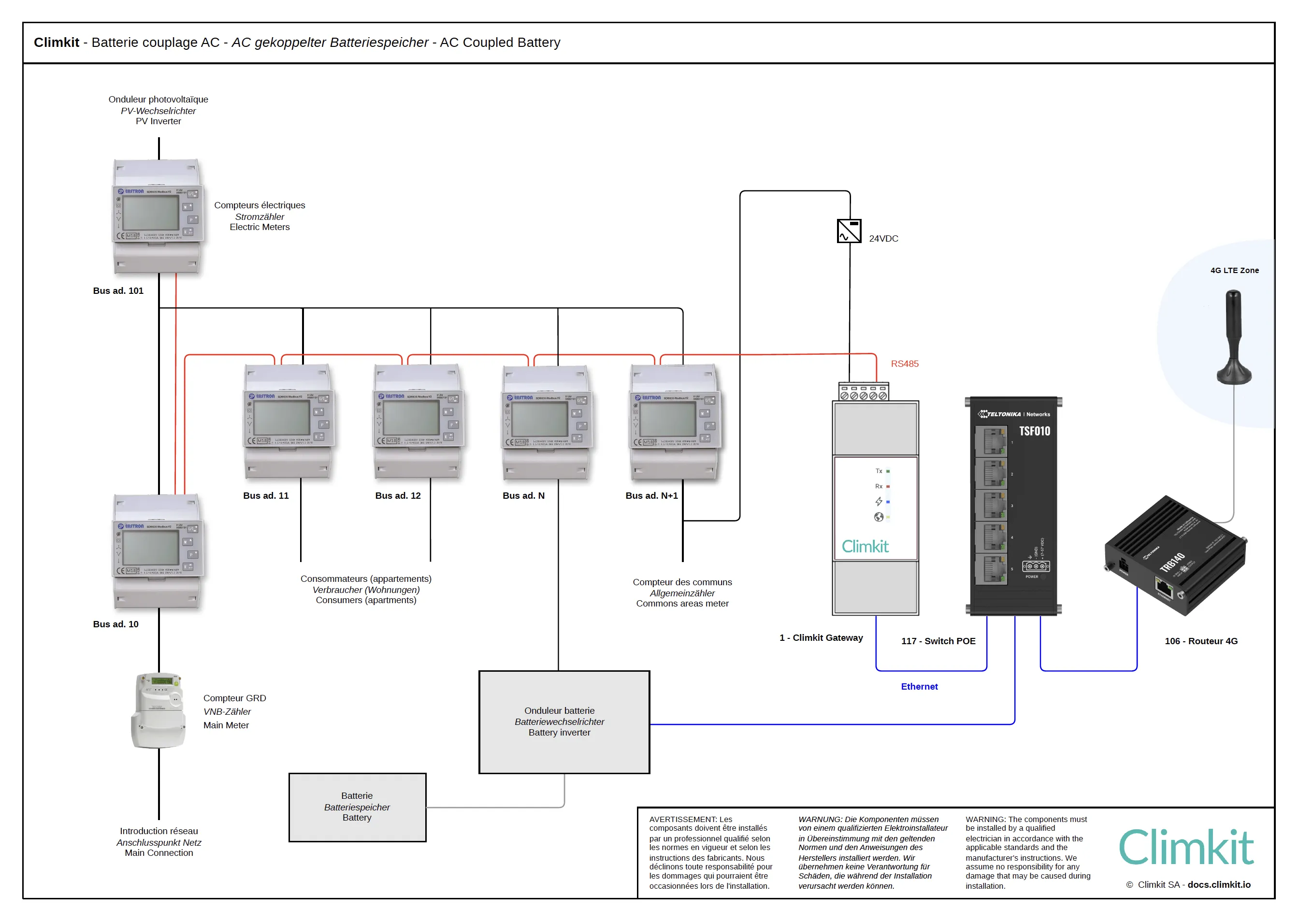
- AC coupling: the battery is connected to the electrical panel via its own inverter, independently of the photovoltaic inverter.
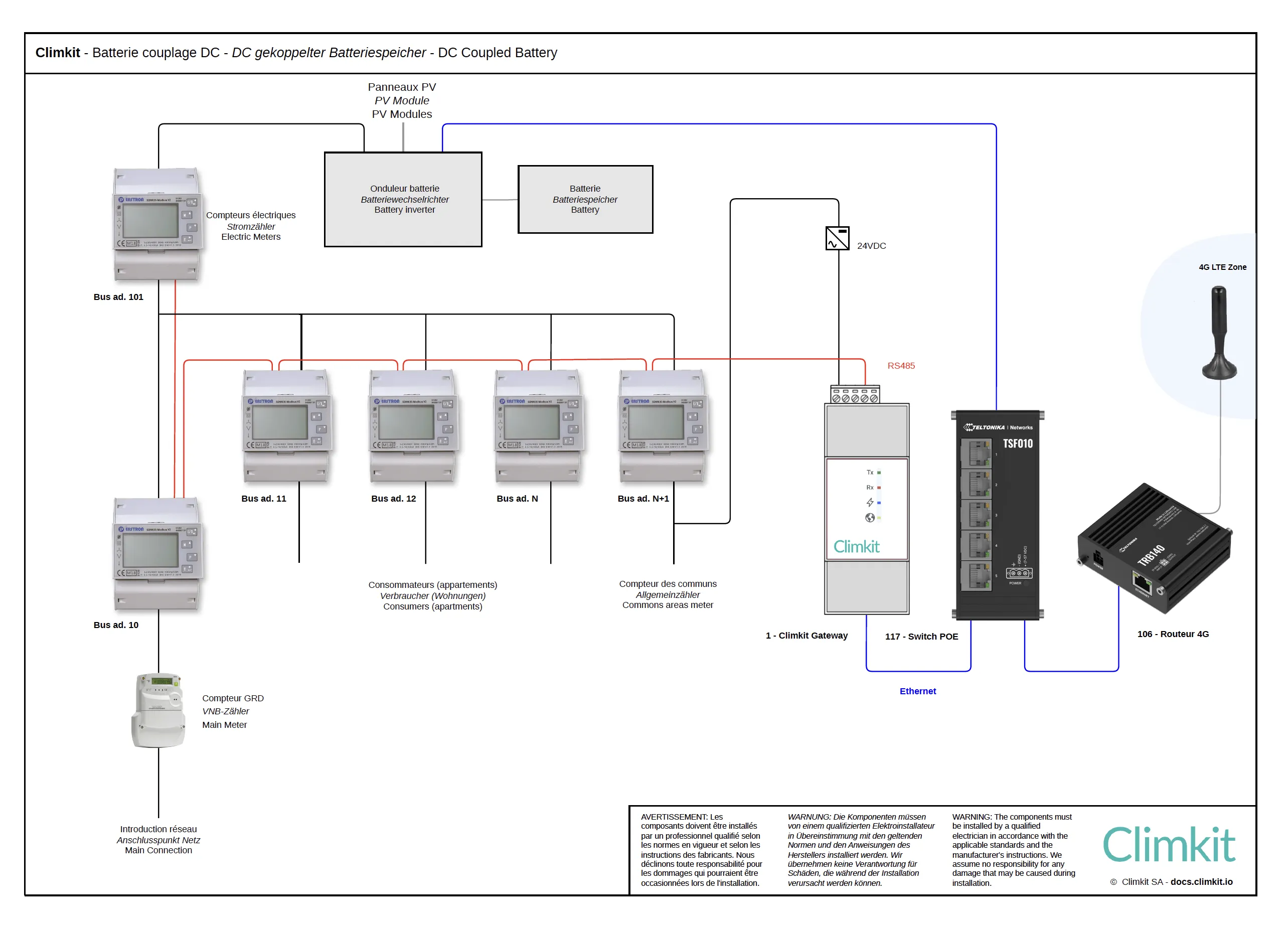
- DC coupling: the battery is connected directly to the photovoltaic inverter, known as a hybrid inverter.
AC coupling
AC coupling is recommended for medium and large installations, or when a standard photovoltaic inverter is already installed.
The battery, equipped with its own inverter, is connected to the electrical panel as an independent feeder. A dedicated Climkit private meter is installed on this connection and configured in "Battery" mode on the platform, in order to measure charged and discharged volumes and integrate them correctly into the site's metering.
DC coupling
In DC coupling, the battery is connected directly to the hybrid photovoltaic inverter on the direct current side. This configuration is suitable for installations, generally small to medium-sized, equipped with a hybrid inverter. Since the battery is behind the photovoltaic production meter, no dedicated battery meter is installed. If the Climkit Gateway can read the hybrid inverter via Modbus TCP, the platform distinguishes solar production from battery flows.
Climkit offer
Here are the additional products allowing battery management:
- Equipment:
- Ethernet switch, if necessary to connect the battery
- Software features:
- Battery management
- Commissioning service:
- Technical coordination and configuration
All these products are ordered directly from Climkit. As a general rule, an on-site intervention by a Climkit technician is not required for commissioning. Components are delivered preconfigured, allowing the installer to easily carry out commissioning, with telephone assistance from Climkit technical support if needed.
3. Next steps
Device control:
Storage battery: